
SEO Focus Keywords: Apple iPhone 2026, iPhone 18 Pro display, iPhone 18 Pro Max screen, iPhone Duo foldable display, iPhone Air OLED screen, iPhone 17 OLED-display, iPhone LCD screen replacement, smartphone display materials, OLED screen technology, wholesale mobile phone screens.
Meta Description: Explore Apple’s 2026 iPhone lineup, inclusief iPhone 18 Pro, ProMax, iPhone Duo, iPhone Air and iPhone 17. Learn about OLED structures, display materials, manufacturing and replacement screen sourcing.
1. Overview of Apple’s Latest iPhone Product Lineup
Apple continues to push the boundaries of smartphone design and display engineering. By November 2026, its product lineup includes the iPhone 18 Pro, iPhone 18 ProMax, and the company’s first foldable smartphone, the iPhone Duo. The iPhone Air also remains an important option for customers who prefer an ultra-thin and lightweight design, while the iPhone 17 family continues to attract buyers looking for powerful performance and a more established product platform. These models represent different approaches to smartphone engineering, but one important feature connects them: advanced OLED display technology. Voor reparatiebedrijven voor mobiele telefoons, groothandelaren, distributeurs, and replacement screen suppliers, understanding these developments is essential because display construction directly influences product quality, verenigbaarheid, repair difficulty, and purchasing costs.
Apple’s display strategy has gradually moved away from conventional LCD technology toward OLED panels across its main iPhone families. This transition has changed the materials used in screen assemblies, the manufacturing processes required, and the technical standards expected from replacement display suppliers. It also means that buyers should distinguish between traditional LCD replacement products and OLED replacement assemblies rather than assuming that every iPhone screen belongs to the same category.
iPhone 18 Pro, iPhone 18 Pro Max and iPhone Duo
De iPhone 18 Pro and iPhone 18 Pro Max were introduced in September 2026. Both feature advanced Super Retina XDR displays, high-performance hardware, and improved display-related capabilities. Apple’s first foldable smartphone, the iPhone Duo, was introduced during the same launch season and became available in October 2026. Its two-screen design represents a significant change in Apple’s smartphone architecture.
The iPhone Duo has a 5.4-inch external display and a 7.6-inch internal folding display. Its flexible screen construction requires different materials and manufacturing techniques from conventional rigid smartphone displays. The product uses a precision-engineered hinge, reinforced internal structures, specialized adhesives, and protective layers designed to withstand repeated folding.
iPhone Air and the iPhone 17 Serie
The iPhone Air, introduced in September 2025, remains a distinctive product in Apple’s lineup because of its extremely thin titanium construction and lightweight design. Its 6.5-inch OLED display demonstrates how manufacturers can combine a relatively large screen with a slim device body.
De iPhone 17, iPhone 17 Pro, en iPhone 17 Pro Max also remain relevant products in the replacement screen market. Their OLED panels offer high resolution, uitstekend contrast, en adaptieve vernieuwingsfrequenties. These characteristics create opportunities for aftermarket screen manufacturers that can deliver reliable replacement assemblies at competitive wholesale prices.
2. Understanding Apple’s Modern Display Technology
Before examining individual models, it is important to understand the difference between LCD and OLED displays. These two technologies use different methods to produce images, and their internal structures are not interchangeable.
OLED versus. LCD: Belangrijkste verschillen
Een LCD, or Liquid Crystal Display, uses a backlight to illuminate liquid crystal molecules. The crystals control how much light passes through color filters to create the image. Even when displaying black, the backlight may still produce some light, which limits the contrast ratio compared with OLED.
An OLED, or Organic Light-Emitting Diode, werkt anders. Each pixel generates its own light through organic electroluminescent materials. Individual pixels can switch off completely, creating deep blacks and excellent contrast without requiring a separate backlight.
| Functie | LCD Display | OLED Display |
|---|---|---|
| Light source | LED backlight | Zelf-emitterende pixels |
| Black performance | Limited by backlight leakage | Individual pixels switch off |
| Contrast | Generally lower | Extreem hoog |
| Panel thickness | Requires backlight assembly | Can be thinner |
| Stroomverbruik | Depends on backlight and image | Depends on displayed content |
| Flexibiliteit | Generally rigid | Can use flexible substrates |
| Manufacturing | Mature and relatively economical | More complex material deposition |
| Common applications | Budget smartphones and older iPhones | Modern premium smartphones |
For replacement screen buyers, the difference is especially important. An LCD screen cannot simply replace an OLED assembly without considering the device’s electrical design, display connector, firmware compatibility, mechanical dimensions, en aanraakfunctionaliteit.
Why Apple Has Transitioned to OLED Displays
OLED offers several advantages that align with Apple’s premium smartphone strategy. Its self-emissive structure allows thinner display assemblies, Dieper zwarten, and more precise pixel-level brightness control. OLED also supports flexible panel designs, which makes it particularly suitable for foldable devices.
Echter, OLED manufacturing requires sophisticated equipment and careful material control. Organic emissive materials must be deposited accurately, thin-film transistor circuits must operate consistently, and encapsulation must protect sensitive layers from moisture and oxygen.
Voor groothandelaars, this technological difference has practical consequences. OLED replacement screens generally require more advanced manufacturing capabilities and stricter quality inspections than conventional LCD assemblies. Buyers should evaluate brightness, kleurconsistentie, aanrakingsprestaties, verenigbaarheid, and panel durability instead of comparing products by price alone.
3. Internal Structure of an iPhone OLED Display
An OLED screen is not simply one piece of glass with a colorful panel underneath. It is a carefully integrated assembly containing several functional layers. Each layer performs a specific job, and the overall performance depends on how well these materials work together.
Afdekglas, Protective Coatings and Touch Layers
The outermost part of a modern iPhone display is its protective cover structure. Apple uses Ceramic Shield materials on the front of several recent iPhone generations. These materials are designed to improve resistance to scratches and impact damage, although no smartphone cover material is completely unbreakable.
Below the protective surface, additional optical coatings help reduce reflections, improve visibility, and resist fingerprints. An oleophobic coating reduces oil accumulation from everyday handling, while anti-reflective treatments improve readability in bright environments.
The touch-sensing layer detects finger movements and converts them into electrical signals. Depending on the panel architecture, touch electrodes may be integrated into the display structure rather than manufactured as an entirely separate layer. This integration helps reduce thickness and improve optical performance.
OLED Panel, Thin-Film Transistors and Flexible Substrates
The OLED panel contains millions of individual pixels. Each pixel includes red, groente, and blue subpixels that combine to produce different colors. Organic emissive materials generate light when electrical current passes through them.
The thin-film transistor, or TFT, backplane controls the electrical operation of each pixel. Modern smartphone OLED panels commonly use advanced TFT technologies, including low-temperature polycrystalline silicon (LTPS) and oxide-based technologies such as IGZO, depending on the manufacturer’s design.
Flexible OLED panels commonly use polyimide (PI) substrates rather than conventional rigid glass substrates. PI provides flexibility and can withstand the thermal conditions involved in manufacturing. This material is particularly important for curved and foldable display applications.
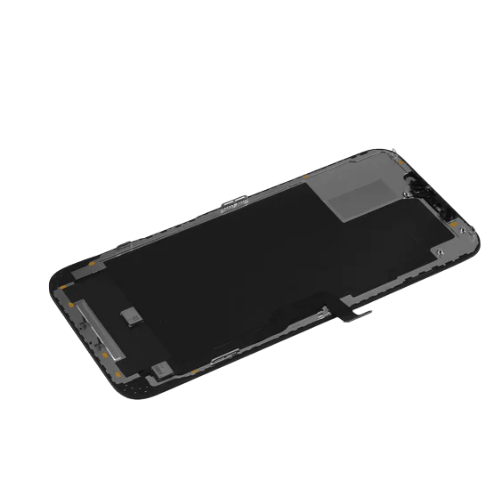
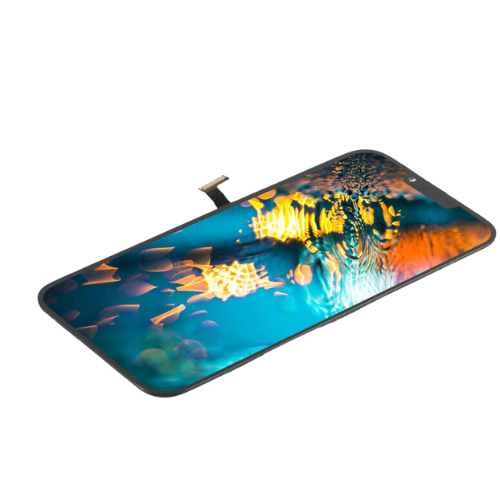
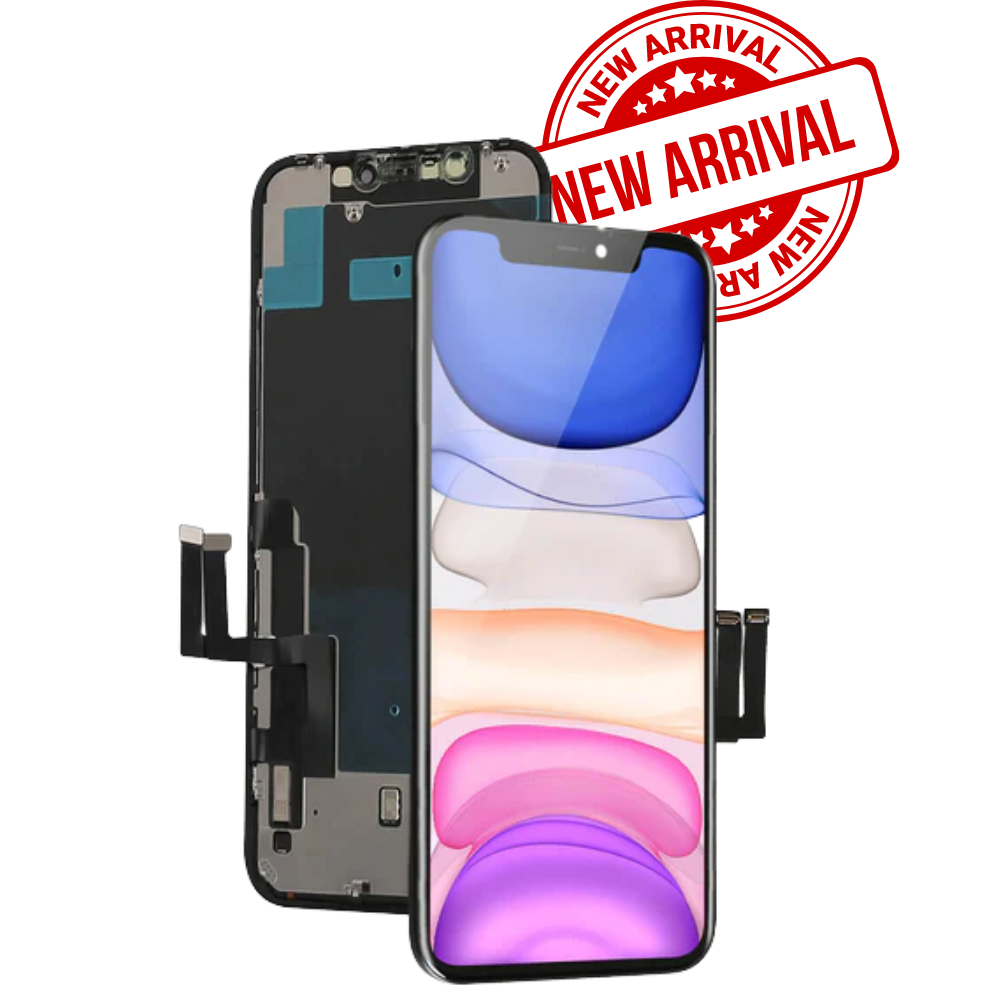
A simplified OLED display structure can be understood as follows:
- Protective cover glass or flexible cover material.
- Optical coatings and protective surface treatments.
- Touch-sensing electrodes.
- Thin-film encapsulation and barrier layers.
- Organic light-emitting diode layers.
- TFT pixel-control backplane.
- Flexible or rigid substrate.
- Supporting films, optical adhesives, and mechanical reinforcement.
The exact layer arrangement varies by manufacturer and panel generation. Apple does not publish the complete proprietary material stack for every iPhone display, so replacement screen manufacturers must rely on their own engineering analysis and production specifications.
4. Display Materials Used in the iPhone 18 Pro en ProMax
De iPhone 18 Pro and Pro Max represent Apple’s premium conventional smartphone display category in 2026. Their display assemblies combine high-resolution OLED technology with advanced surface protection, precise touch sensing, and sophisticated display control.
At the outer level, protective glass and specialized coatings help resist scratches and reduce reflections. Beneath this surface, optical bonding materials connect the different components while minimizing unwanted reflections and air gaps. The OLED panel then provides the image-producing structure, while the TFT backplane controls individual pixels.
The materials used in a modern OLED assembly may include:
- Cover materials: strengthened glass or other engineered protective materials.
- Optical adhesives: optically clear adhesive (OCA) or liquid optically clear adhesive (LOCA), depending on the bonding process.
- Touch electrodes: transparent conductive materials such as indium tin oxide (DIT) or alternative conductive structures.
- Organic emissive compounds: materials that produce light under electrical excitation.
- TFT backplane: silicon-based or oxide-based semiconductor structures.
- Encapsulation materials: thin-film barrier layers that protect organic compounds from moisture and oxygen.
- Support films: polymer films, cushioning materials, and structural components.
A major consideration for screen replacement suppliers is that display performance depends on the complete assembly rather than just the OLED panel. A panel with excellent image quality can still produce poor customer feedback if the touch layer is unstable, the adhesive bonding is inconsistent, or the protective glass has insufficient durability.
De iPhone 18 Pro models also feature ProMotion technology and advanced brightness control. Replacement screen manufacturers therefore need to pay attention to refresh-rate behavior, uniformiteit van de helderheid, kleurnauwkeurigheid, and display communication compatibility.
Voor groothandelkopers, the most useful approach is to request actual sample testing before committing to large orders. A specification sheet may describe the screen’s theoretical capabilities, but real-world inspection provides a much better indication of manufacturing consistency.
5. iPhone Duo: Foldable OLED Display Structure and Materials
The iPhone Duo is particularly interesting from a display engineering perspective because it introduces a folding screen into Apple’s smartphone ecosystem.
Unlike conventional rigid smartphone displays, a foldable OLED panel must withstand repeated bending without developing visible cracks, permanent deformation, or electrical failures. This requires a carefully engineered combination of flexible materials and mechanical support structures.
Apple’s published specifications describe a 7.6-inch internal display and a 5.4-inch external display. The inner screen uses a specialized nano-texture surface treatment designed to reduce glare and reflections. Apple also describes a custom polymer cover layer, high-strength glass components above and below the folding panel, specialized adhesives, and a titanium support plate.
These components work together to manage mechanical stress during opening and closing. The precision hinge controls movement, while internal support structures help maintain the panel’s shape when the device is unfolded.
The main materials and structural considerations include:
Flexible OLED substrate: The flexible substrate provides the foundation for the display’s bending capability. Polyimide-based materials are commonly used in flexible OLED manufacturing because of their mechanical flexibility and thermal stability.
Flexible cover and protective polymer: Unlike conventional rigid cover glass, the folding screen requires a specially engineered protective surface that can tolerate repeated bending.
Thin-film encapsulation: Organic OLED materials are highly sensitive to oxygen and moisture. Thin-film encapsulation provides a protective barrier while maintaining flexibility.
Specialized optical adhesives: Adhesive layers help bond the different display components while allowing controlled movement during folding.
Reinforcement structures: Support films and engineered metal components distribute mechanical stress and improve structural stability.
For screen wholesalers and repair businesses, foldable displays present a different sourcing challenge. A replacement assembly must maintain not only image quality and touch accuracy but also folding performance, surface durability, and compatibility with the hinge structure.
A conventional flat OLED replacement cannot be treated as an equivalent alternative. Buyers should evaluate the complete folding display assembly, including its protective materials, mechanische structuur, and electrical compatibility.
6. iPhone Air: Ultra-Thin Display Engineering
The iPhone Air demonstrates another important direction in smartphone design: reducing device thickness without sacrificing premium display performance.
Its 6.5-inch Super Retina XDR OLED display has a resolution of 2736 × 1260 pixels and a pixel density of 460 pixels per inch. The device is approximately 5.64 mm thick, making its internal component arrangement particularly challenging.
A thinner smartphone leaves less physical space for the battery, weergave montage, moederbord, camera's, and thermal management components. Vervolgens, display manufacturers must carefully control panel thickness, bonding materials, mechanical tolerances, and component integration.
The OLED structure provides an advantage because it does not need the traditional backlight module used in LCD displays. This allows a thinner optical assembly while maintaining high image quality.
Echter, thin construction also creates challenges for replacement screen production. Even small differences in thickness, adhesive positioning, frameafmetingen, or connector placement can affect installation quality.
For aftermarket suppliers, producing an iPhone Air replacement screen is not simply a matter of manufacturing a panel with matching dimensions. The complete assembly must fit the original device architecture and maintain reliable touch and display functionality.
The iPhone Air also illustrates why manufacturers should pay attention to the relationship between mechanical design and display technology. As smartphones become thinner, material selection and precision assembly become increasingly important.
7. iPhone 17, 17 Pro and 17 ProMax: Display Technology Analysis
De iPhone 17 family remains an important category for the mobile phone replacement market in 2026. Its OLED technology offers a combination of high resolution, uitstekende kleurweergave, and adaptive refresh-rate performance.
De standaard iPhone 17 features a 6.3-inch OLED display with a resolution of 2622 × 1206 pixels and 460 ppi. De iPhone 17 Pro also uses a 6.3-inch OLED display, while the Pro Max offers a larger 6.9-inch display.
| Model | Weergavegrootte | Technologie | Oplossing | Pixeldichtheid |
|---|---|---|---|---|
| iPhone 17 | 6.3 inch | OLED | 2622 × 1206 | 460 ppi |
| iPhone 17 Pro | 6.3 inch | OLED | 2622 × 1206 | 460 ppi |
| iPhone 17 ProMax | 6.9 inch | OLED | 2868 × 1320 | 460 ppi |
| iPhone Air | 6.5 inch | OLED | 2736 × 1260 | 460 ppi |
All these models support advanced display features, including ProMotion with adaptive refresh rates up to 120Hz, HDR, and wide color reproduction.
Vanuit productieperspectief, the display assemblies share several fundamental technologies, but their dimensions, connectoren, mechanical structures, and device-specific specifications are different. A replacement screen designed for one model should never be assumed to fit another model simply because both use OLED technology.
De iPhone 17 generation is particularly relevant for wholesale buyers because it combines relatively recent display technology with an established installed user base. As more devices enter the repair market, demand for replacement assemblies can increase.
Suppliers should maintain accurate model identification, product labeling, and quality records to avoid compatibility problems.
8. OLED Manufacturing Processes and Quality Control
Manufacturing a reliable OLED smartphone display involves several sophisticated processes. These include substrate preparation, TFT backplane fabrication, organic material deposition, inkapseling, aanrakingsintegratie, optical bonding, and final assembly.
Each manufacturing stage requires accurate process control. Even minor contamination or material defects can affect pixel performance, kleuruniformiteit, or long-term reliability.
After the OLED panel is produced, manufacturers integrate the necessary touch and protective components. Optical adhesives are applied under controlled conditions to reduce bubbles and improve bonding quality. The finished display is then tested for electrical performance, helderheid, kleurweergave, en aanrakingsgevoeligheid.
For replacement screen factories, a comprehensive quality-control process should include:
- Dead-pixel and abnormal-pixel inspection.
- Brightness and color uniformity testing.
- Touch sensitivity and multi-touch testing.
- Display connector and electrical-function testing.
- Screen surface and coating inspection.
- Adhesive bonding and bubble inspection.
- Long-duration operating tests.
- Model compatibility and installation checks.
A reliable supplier should also maintain traceable production batches. This makes it easier to identify the cause of recurring defects and improve manufacturing consistency.
9. Common iPhone Screen Failures and Replacement Considerations
Even premium smartphone displays can experience problems during everyday use. Accidental drops, druk schade, blootstelling aan vloeistoffen, fabricagefouten, and long-term wear can all affect display performance.
Some common OLED screen problems include black spots, vertical lines, green or pink discoloration, flikkerend, aanraking mislukt, and partial display loss. Physical damage may affect only the cover glass, but more serious impacts can damage the underlying OLED panel and touch circuitry.
Foldable displays introduce additional considerations because repeated bending places mechanical stress on the flexible layers and protective structures.
When selecting a replacement screen, repair technicians should first identify which component has failed. Replacing only the cover glass may be possible when the underlying panel and touch layer remain functional and the repair facility has suitable refurbishment equipment. Echter, when the OLED panel itself is damaged, a complete display assembly is often the more practical repair option.
Correct diagnosis reduces unnecessary repair costs and helps prevent customer complaints.
10. Origineel, Refurbished and Aftermarket iPhone Displays
The replacement screen market offers several product categories, and buyers should understand their differences before placing wholesale orders.
| Schermtype | Main Characteristics | Typical Buyer Considerations |
|---|---|---|
| Original service-pack | Manufacturer-authorized replacement part | Authenticity, availability and price |
| Original pulled | Removed from an existing device | Voorwaarde, testing and refurbishment history |
| Refurbished original | Original panel with replaced surface glass or refurbished components | Refurbishment quality and panel condition |
| Aftermarket-OLED | Newly manufactured compatible OLED assembly | Helderheid, kleur, touch and compatibility |
| Zachte OLED | Flexible OLED construction | Flexibiliteit, installation and product consistency |
| Harde OLED | OLED panel using a more rigid supporting structure | Prijs, thickness and mechanical characteristics |
| Incell-LCD | LCD technology with integrated touch structure | Lower cost and device-specific compatibility |
Not all replacement screen categories are available for every iPhone model. Buyers should confirm the actual technology used in each product rather than relying only on marketing descriptions.
Bijvoorbeeld, an aftermarket OLED replacement should not automatically be described as an original Apple screen. Clear product classification protects both suppliers and customers from misunderstandings.
11. How to Select Reliable iPhone LCD and OLED Screen Suppliers
Choosing a reliable mobile phone screen supplier is one of the most important decisions for wholesalers and repair businesses. A low purchase price may look attractive, but poor quality can lead to higher return rates, installation problems, garantieclaims, and damage to customer relationships.
The first step is to verify the supplier’s actual product range. A professional supplier should be able to identify the exact iPhone model, weergavetechnologie, assembly type, and available quality grades.
The second step is to evaluate sample quality. Testing should cover brightness, kleurweergave, aanraakgevoeligheid, pixeldefecten, verenigbaarheid, and installation performance.
The third step is to understand the supplier’s quality-control and warranty policies. A clear warranty process provides protection when products develop manufacturing defects after delivery.
Buyers should also evaluate packaging, verzendmethoden, delivery times, and communication efficiency. Voor internationale groothandels, stable inventory and reliable logistics are just as important as technical product quality.
Voordat u een grote bestelling plaatst, consider requesting samples from several suppliers and comparing their performance under the same testing conditions.
12. Toekomstige trends in smartphonedisplay -technologie
Smartphone display technology will continue to evolve as manufacturers compete to deliver thinner, helderder, duurzamer, and more energy-efficient products.
One important development is the continued improvement of flexible OLED panels. Foldable devices require materials that can tolerate repeated bending while maintaining stable image quality. Research into advanced polymers, beschermende coatings, thin-film encapsulation, and mechanical reinforcement will remain important.
Another direction is the development of more efficient OLED structures. Improvements in organic emissive materials, pixel architecture, and display-driving circuits can help reduce power consumption while improving brightness and color performance.
Manufacturers are also exploring more sophisticated surface technologies. Anti-reflective coatings, scratch-resistant materials, and improved optical bonding can make smartphone screens easier to use in different lighting conditions.
For replacement screen suppliers, these developments mean that technical capability will become an increasingly important competitive advantage. Businesses that understand display materials, product compatibility, quality testing, and supply-chain management will be better positioned to serve the global repair and wholesale markets.
Conclusie
Apple’s latest iPhone lineup demonstrates how smartphone display technology is evolving from conventional rigid OLED assemblies toward thinner, more sophisticated, and increasingly flexible display structures. De iPhone 18 Pro and Pro Max continue to develop premium OLED technology, while the iPhone Duo introduces new engineering challenges associated with foldable displays. The iPhone Air highlights the importance of ultra-thin component integration, and the iPhone 17 series remains an important product family for the replacement screen market.
For mobile phone screen wholesalers, distributeurs, en reparatiebedrijven, understanding these technologies is essential when selecting products and evaluating suppliers. Cover materials, OLED panel construction, TFT-backplanes, aanrakingsintegratie, optical adhesives, and protective coatings all influence screen quality and reliability.
As OLED technology continues to advance, the replacement screen market will require better manufacturing capabilities, stricter quality control, and more accurate product compatibility management. Whether you are purchasing original replacement screens, gerenoveerde beeldschermen, or aftermarket OLED assemblies, choosing a dependable supplier is the foundation of long-term business success.
If you are looking for a professional mobile phone LCD and OLED screen supplier in China, working with an experienced wholesale partner can help you improve purchasing efficiency, control inventory costs, and develop a more competitive product range.
Need mobile phone LCD screens, OLED-schermen, or mobile phone accessories? Contact us for wholesale inquiries and product information.
Contact Person: Manager Loly Jiang
E-mail: Mophoneparts@outlook.com
WhatsApp: +86 137 1130 8199
We welcome inquiries from mobile phone repair shops, groothandelaren, distributeurs, and international business partners. Feel free to contact us for product catalogs, quotations, samples, and customized sourcing solutions.
Veelgestelde vragen (FAQ's)
1. Heeft de iPhone 18 Pro use an LCD or OLED display?
De iPhone 18 Pro uses Apple’s Super Retina XDR OLED display technology. OLED-pixels genereren hun eigen licht, providing deep blacks, hoog contrast, and excellent color reproduction. It does not use a conventional LCD backlight structure.
2. What display technology does Apple’s first foldable iPhone Duo use?
The iPhone Duo features two Super Retina XDR displays, including a 5.4-inch external display and a 7.6-inch internal folding display. The internal screen uses specialized flexible display engineering, protective polymer materials, high-strength glass components, and advanced adhesive structures designed to accommodate repeated folding.
3. What is the difference between Soft OLED and Hard OLED replacement screens?
Soft OLED uses a flexible substrate, commonly based on polyimide, while Hard OLED generally uses a more rigid supporting structure. Soft OLED is designed to provide greater flexibility and can offer a thinner construction. Hard OLED is generally a more economical alternative, although its mechanical characteristics and thickness may differ. Actual quality depends on the manufacturer and production process.
4. Can an LCD screen replace an OLED screen on an iPhone?
Niet noodzakelijkerwijs. LCD and OLED displays have different electrical structures, panel dimensions, and power requirements. A replacement must be specifically engineered and validated for the target iPhone model. Buyers should always confirm model compatibility and display technology before purchasing.
5. How can international wholesalers find reliable iPhone replacement screen suppliers in China?
International wholesalers should evaluate suppliers based on product quality, manufacturing experience, monster testen, model dekking, quality-control procedures, garantiebeleid, and delivery reliability. It is advisable to test samples before placing bulk orders. A supplier that offers consistent quality, accurate product information, and responsive after-sales support can help reduce business risks.