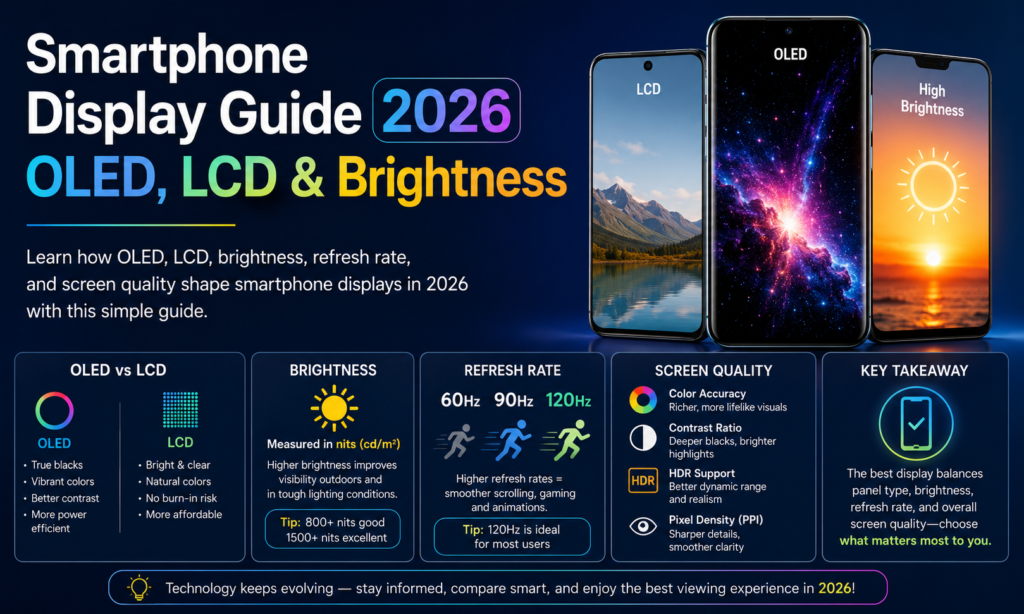
Smartphonedisplays zijn een van de belangrijkste verkoopargumenten in de mobiele industrie geworden. Een paar jaar geleden, kopers gaven vooral om de processorsnelheid en cameramegapixels. Vandaag, het eerste wat mensen opmerken is het scherm. Of je nu door TikTok scrollt, Netflix kijken, spelletjes spelen, of het beantwoorden van e-mails, uw hele ervaring hangt af van de kwaliteit van het scherm. Een smartphonescherm is niet langer alleen maar een stuk glas. Het is het venster tussen mens en technologie, bijna als het stuur van een sportwagen. Als de besturing goedkoop aanvoelt, de hele auto voelt teleurstellend. Hetzelfde gebeurt met mobiele beeldschermen.
In 2026, De weergavetechnologie van smartphones ontwikkelt zich sneller dan ooit. Grote fabrikanten houden van Samsung-scherm, LG-scherm, En TCL CSOT drijven de helderheidsniveaus verder 3000 nits terwijl de energie-efficiëntie en kleurnauwkeurigheid worden verbeterd. Uit recente brancherapporten blijkt dat vlaggenschip-smartphoneschermen nu regelmatig adaptieve vernieuwingsfrequenties hebben, HDR-ondersteuning, ultrahoge pixeldichtheid, en geavanceerde OLED-materialen.
Als u in smartphonereparatie werkt, groothandel, productie, of mobiele accessoires, Het begrijpen van schermspecificaties is niet langer optioneel. Kopers willen betere displays, reparatiewerkplaatsen hebben nauwkeurige productkennis nodig, en leveranciers moeten de verschillen tussen originele en aftermarket-panelen begrijpen. In deze handleiding worden de belangrijkste weergaveparameters van smartphones in eenvoudig Engels uitgelegd, zodat u begrijpt hoe moderne mobiele schermen echt werken.
Waarom smartphoneschermparameters belangrijker zijn dan ooit
Het scherm is de ziel van een smartphone
Stel je voor dat je een dure sportwagen koopt met wazige ruiten. Klinkt belachelijk, rechts? Dat is precies hoe een slecht smartphonescherm aanvoelt 2026. Het scherm bestuurt vrijwel elke interactie die gebruikers hebben met hun apparaten. Van gaming en social media tot online shoppen en fotografie, het display bepaalt of de ervaring premium of frustrerend aanvoelt. Zelfs de snelste processor kan een telefoon met doffe kleuren niet redden, lage helderheid, of een slechte aanrakingsgevoeligheid.
Consumenten zijn tegenwoordig ook hoger opgeleid dan voorheen. Mensen vergelijken vernieuwingsfrequenties, helderheidsniveaus, HDR-certificeringen, en kleurnauwkeurigheid voordat u een aankoop doet. Recensenten van sociale media bespreken voortdurend de nit-niveaus, PWM-dimmen, en LTPO-technologie. Vanwege dit, fabrikanten concurreren agressief om helderder te creëren, scherper, en vloeiendere weergaven. Dat blijkt uit recente rapporten van SID Display Week 2026, Samsung presenteerde OLED-technologie die in staat is om te bereiken 3000 nits helderheid terwijl de kleurverzadiging en efficiëntie worden verbeterd.
Deze concurrentie komt ten goede aan de consument, maar schept ook verwarring. Termen als AMOLED, LTPO, Tft, IPS, en QD-OLED klinken voor veel kopers zeer technisch. Sommige mensen gaan er zelfs van uit dat alle OLED-schermen identiek zijn, wat volkomen verkeerd is. De weergavekwaliteit is afhankelijk van de samenwerking tussen meerdere factoren, inclusief materialen, paneelstructuur, kalibratie, en productieproces.
Waarom kopers en reparatiewerkplaatsen technische kennis nodig hebben
Voor smartphonereparatiewerkplaatsen en groothandels, Het begrijpen van schermparameters is uiterst belangrijk. Klanten vragen vaak of een vervangend scherm origineel is, gerenoveerd, zachte OLED, harde OLED, of aftermarket-LCD. Als verkopers de verschillen niet duidelijk kunnen uitleggen, Klanten verliezen snel hun vertrouwen. Zie het als het kopen van koffie. Als een café het verschil tussen espresso en cappuccino niet kan uitleggen, mensen kunnen twijfelen aan de kwaliteit van de winkel zelf.
Originele beeldschermen van de fabrikant bieden doorgaans een betere helderheid, aanraakgevoeligheid, en duurzaamheid. Aftermarket-panelen zien er op het eerste gezicht misschien hetzelfde uit, maar hebben vaak een zwakkere kleurweergave en een kortere levensduur. In veel budgetvervangingsschermen, de helderheid is lager, aanraaklatentie is hoger, en het batterijverbruik neemt aanzienlijk toe.
Schermspecificaties zijn ook van invloed op de compatibiliteit. Bijvoorbeeld, sommige iPhone- en Samsung Galaxy-apparaten gebruiken flexibele OLED-panelen met specifieke IC-structuren. Het vervangen ervan door goedkopere harde OLED-versies kan de duurzaamheid en weergavekwaliteit verminderen. Als u deze technische details begrijpt, kunnen leveranciers betere voorraden kiezen en kunnen reparatiewerkplaatsen klachten van klanten voorkomen.
Fabrikanten van smartphoneschermen begrijpen
Topfabrikanten van LCD- en OLED-schermen in 2026
De markt voor smartphonedisplays wordt gedomineerd door verschillende mondiale reuzen. Samsung-scherm blijft marktleider op het gebied van OLED-technologie, het leveren van panelen voor Samsung Galaxy-apparaten en zelfs sommige iPhone-modellen. LG-scherm richt zich sterk op geavanceerde OLED-oplossingen en tandem-OLED-technologieën. Chinese fabrikanten houden van BOE-technologie En TCL CSOT breiden zich snel uit en concurreren agressief op zowel de LCD- als de OLED-markt.
Uit recent nieuws uit de sector blijkt dat TCL zwaar investeert in inkjetgeprinte OLED-technologie, waardoor de productiekosten met maximaal kunnen worden verlaagd 30%. Dit is belangrijk omdat lagere productiekosten doorgaans goedkopere OLED-smartphones voor consumenten betekenen. In de tussentijd, Samsung blijft de grenzen van helderheid en efficiëntie verleggen met OLED-technologieën van de volgende generatie die worden getoond op MWC en SID Display Week 2026.
Hier is een eenvoudige vergelijking van de belangrijkste fabrikanten van smartphoneschermen:
| Fabrikant | Belangrijkste technologie | Bekend om |
|---|---|---|
| Samsung-scherm | OLED, AMOLED | Hoge helderheid, premium kwaliteit |
| LG-scherm | Tandem-OLED | Efficiëntie en lange levensduur |
| BOE | LCD & OLED | Concurrerende prijzen |
| TCL CSOT | LCD, OLED | Kosteneffectieve innovatie |
| Scherp | IGZO LCD-scherm | Scherpe beeldkwaliteit |
| Japan Display Inc. | LCD | Stabiele kleurnauwkeurigheid |
De beeldschermfabrikant heeft vaak rechtstreeks invloed op de schermkwaliteit. Zelfs als twee telefoons op papier vergelijkbare specificaties gebruiken, de paneelleverancier kan merkbare verschillen in helderheid creëren, kleur afstemmen, en duurzaamheid.
Originele fabrieks- versus aftermarket-schermen
Een van de grootste misverstanden in de smartphonereparatie-industrie is de overtuiging dat alle vervangende schermen gelijk zijn. Dat zijn ze niet. Originele fabrieksdisplays worden meestal vervaardigd volgens strikte normen met behulp van hoogwaardige materialen en kalibratiesystemen. Aftermarket-displays variëren sterk, afhankelijk van de kwaliteit van de leverancier.
Originele schermen bieden over het algemeen:
- Betere consistentie van de helderheid
- Nauwkeurigere kleuren
- Verbeterde aanraakgevoeligheid
- Langere levensduur
- Lager stroomverbruik
Goedkopere aftermarket-schermen kunnen de kosten verlagen door achtergrondverlichting van lagere kwaliteit te gebruiken, vereenvoudigde IC-chips, of glas van mindere kwaliteit. Dit is de reden waarom sommige vervangende beeldschermen vaag of overdreven blauw lijken. Klanten merken het misschien niet meteen, maar na verloop van tijd wordt het verschil duidelijk.
Zachte OLED-panelen komen doorgaans dichter bij de originele kwaliteit omdat ze flexibele substraten gebruiken die vergelijkbaar zijn met vlaggenschiptelefoons. Harde OLED-panelen zijn goedkoper maar kwetsbaarder. LCD-vervangingen blijven gebruikelijk bij budgetreparaties omdat ze minder kosten, hoewel ze meestal contrast en energie-efficiëntie opofferen.
Displaymaterialen en technologieën
TFT LCD-technologie
TFT LCD staat voor Thin Film Transistor Liquid Crystal Display. Deze technologie bestaat al jaren en domineert nog steeds de markt voor budgetsmartphones. TFT-panelen zijn betaalbaar te vervaardigen, waardoor ze populair zijn in instaptelefoons en goedkope vervangingsschermen.
Het grootste voordeel van TFT LCD is de prijs. Fabrikanten kunnen deze panelen goedkoop en op grote schaal produceren. Echter, TFT-schermen hebben doorgaans zwakkere kijkhoeken en een lagere kleurnauwkeurigheid in vergelijking met IPS- of OLED-technologie. Stel je voor dat je door licht vervuild glas naar een schilderij kijkt. Je kunt het beeld nog steeds zien, maar het mist rijkdom en diepgang.
TFT-schermen zijn ook sterk afhankelijk van achtergrondverlichting. In tegenstelling tot OLED, die elke pixel afzonderlijk verlicht, LCD-panelen hebben een aparte verlichtingslaag achter het scherm nodig. Dit beperkt de contrastprestaties omdat zwarte gebieden nooit echt zwart zijn. In plaats van, donkere scènes kunnen grijsachtig lijken.
Toch, TFT LCD-technologie speelt nog steeds een belangrijke rol in de mobiele industrie. Budget-smartphones en reparatiemarkten vertrouwen erop omdat betaalbaarheid belangrijk is. Voor gebruikers die voornamelijk op sociale media surfen of berichtenapps gebruiken, TFT-schermen kunnen nog steeds acceptabele prestaties leveren.
IPS LCD-technologie
IPS-LCD, of LCD-scherm voor in-plane-switching, is een grote verbetering ten opzichte van traditionele TFT-panelen. IPS-technologie biedt bredere kijkhoeken, betere kleurnauwkeurigheid, en stabielere helderheid. Veel smartphones uit het middensegment gebruiken nog steeds IPS LCD omdat dit de balans biedt tussen kwaliteit en kosteneffectiviteit.
Eén van de redenen waarom IPS-schermen populair blijven is oogcomfort. Sommige gebruikers ervaren ongemak bij OLED PWM-dimmen, wat flikkergevoeligheid kan veroorzaken. LCD-schermen vermijden dit probleem over het algemeen omdat hun achtergrondverlichting anders werkt. Online discussies in displaygemeenschappen blijven dit verschil benadrukken 2026.
IPS LCD-panelen presteren ook goed op het gebied van kleurconsistentie. Grafische ontwerpers en fotografen geven soms de voorkeur aan goed gekalibreerde IPS-schermen omdat kleuren natuurlijk overkomen in plaats van overdreven verzadigd. Dat gezegd hebbende, IPS-technologie kan niet volledig concurreren met OLED-contrastniveaus.
OLED- en AMOLED-materialen
OLED-technologie heeft de smartphone-industrie dramatisch veranderd. OLED staat voor Organic Light Emitting Diode, wat betekent dat elke pixel zijn eigen licht creëert. Hierdoor zijn echte zwarte kleuren mogelijk omdat pixels volledig kunnen worden uitgeschakeld. AMOLED is simpelweg een geavanceerde versie met actieve matrixtechnologie voor snellere bediening.
Moderne OLED-panelen bieden:
- Oneindige contrastverhoudingen
- Diepe zwarten
- Snellere reactietijden
- Betere HDR-prestaties
- Dunnere displaystructuren
Recente ontwikkelingen in de sector laten zien dat de helderheid van OLED ongelooflijke niveaus bereikt. Samsung heeft onlangs aangetoond dat OLED-panelen voor smartphones daartoe in staat zijn 3000 nits helderheid. In de tussentijd, De nieuwste tandem-OLED-technologieën van LG verbeteren de efficiëntie en verdubbelen de levensduur van het paneel.
OLED-schermen zijn als moderne sportwagens. Ze zien er prachtig uit, presteren ongelooflijk snel, en voel je premium. Echter, ze brengen ook uitdagingen met zich mee, zoals het risico op inbranden en hogere productiekosten.
LTPO en flexibele OLED uitgelegd
LTPO-technologie is een van de grootste innovaties op het gebied van premium smartphoneschermen. LTPO staat voor Low-Temperature Polycrystalline Oxide. Het maakt adaptieve vernieuwingsfrequenties mogelijk die dynamisch veranderen tussen 1 Hz en 120 Hz, afhankelijk van de inhoud.
Dit is belangrijk omdat de vernieuwingsfrequentie een grote invloed heeft op de levensduur van de batterij. Voor het kijken naar een statisch beeld zijn geen bewegingen van 120 Hz nodig. LTPO-panelen verlagen op intelligente wijze de vernieuwingsfrequentie om energie te besparen. Het is vergelijkbaar met het efficiënt besturen van een auto door het motortoerental te verlagen wanneer u bergafwaarts rijdt.
Flexibele OLED-panelen zijn een andere belangrijke vooruitgang. In tegenstelling tot stijve harde OLED-schermen, flexibele OLED-panelen buigen lichtjes, het verbeteren van de duurzaamheid en het mogelijk maken van ontwerpen met gebogen randen. De meeste vlaggenschip-smartphones gebruiken nu flexibele OLED-structuren omdat ze dunner zijn en beter bestand tegen schade.
Schermresolutie en pixeldichtheid
HD, FHD, 2K, en 4K-resoluties
Resolutie bepaalt hoeveel pixels er op het scherm verschijnen. Meer pixels betekenen meestal scherpere afbeeldingen en duidelijkere tekst. Smartphone-resoluties omvatten gewoonlijk:
| Oplossing | Algemene naam | Typische kwaliteit |
|---|---|---|
| 720P | HD | Budgettelefoons |
| 1080P | Full-HD | Middenklasse standaard |
| 1440P | 2K/QHD | Premium vlaggenschip |
| 2160P | 4K | Zeldzaam bij smartphones |
Een hogere resolutie verbetert de details, vooral voor gamen, fotografie, en videostreaming. Echter, meer pixels vereisen ook meer verwerkingskracht en batterijverbruik. Fabrikanten balanceren voortdurend de visuele kwaliteit tegen efficiëntie.
Waarom PPI belangrijk is voor visuele kwaliteit
PPI betekent Pixels Per Inch. Het meet de pixeldichtheid. Een hogere PPI zorgt voor scherpere beelden omdat individuele pixels moeilijker op te merken zijn. Premium-smartphones overschrijden tegenwoordig vaak de grens 450 PPI.
Bijvoorbeeld, vlaggenschipdisplays van Google en Samsung beschikken nu over een ultrahoge pixeldichtheid in combinatie met adaptieve vernieuwingstechnologie en HDR-ondersteuning. Op normale kijkafstanden, alles hierboven 400 PPI lijkt meestal extreem scherp voor het menselijk oog.
Helderheid en zichtbaarheid buitenshuis
Typische helderheid versus piekhelderheid
De helderheid wordt gemeten in nits. Een nit geeft aan hoeveel licht het scherm uitstraalt. De helderheid van smartphones is een belangrijk marketingstrijdtoneel geworden, omdat gebruikers buitenshuis duidelijk zicht verwachten.
Typische helderheid verwijst naar normale aanhoudende helderheid tijdens regelmatig gebruik. Piekhelderheid vertegenwoordigt tijdelijke maximale helderheid onder HDR- of zonlichtomstandigheden. Moderne vlaggenschip OLED-schermen kunnen dit overschrijden 3000 nits piekhelderheid.
Dat helderheidsniveau is bijna alsof je een mini-zaklamp in je zak draagt. De leesbaarheid buitenshuis verbetert dramatisch, vooral in direct zonlicht.
HDR en High-Nit-schermen in 2026
HDR staat voor High Dynamic Range. HDR-schermen tonen tegelijkertijd helderdere highlights en diepere schaduwen. Het bekijken van HDR-films op een premium OLED-scherm voelt alsof je door een schoon raam kijkt in plaats van door een mistig raam.
Fabrikanten blijven de helderheidsverbeteringen agressief doorvoeren 2026. Samsung en LG presenteerden beide geavanceerde OLED-technologieën met een hogere helderheid en een breder kleurengamma.
Vernieuwingsfrequentie en aanraaksamplingfrequentie
60Hz versus 120 Hz versus 144 Hz
De vernieuwingsfrequentie meet hoe vaak het scherm elke seconde wordt bijgewerkt. Een 60Hz-scherm wordt vernieuwd 60 keer per seconde, terwijl 120 Hz ververst 120 keer.
Hogere vernieuwingsfrequenties zorgen voor vloeiendere scroll- en game-ervaringen. Zodra gebruikers 120Hz-schermen ervaren, terugkeren naar 60Hz voelt vaak schokkerig, bijna alsof je van een sportwagen terugschakelt naar een fiets.
Waarom gamers belang hechten aan aanraakreactie
De aanraakbemonsteringsfrequentie bepaalt hoe snel het scherm vingerinvoer detecteert. Competitieve gamers vinden dit erg belangrijk, omdat een snellere respons de reactietijden verbetert.
Op gaming gerichte smartphones beschikken nu over extreem hoge aanraakbemonsteringsfrequenties in combinatie met adaptieve vernieuwingstechnologieën. Deze verbeteringen verminderen de invoervertraging en zorgen voor vloeiendere gameplay-ervaringen.
Kleurnauwkeurigheid en contrastverhouding
sRGB, DCI-P3, en kleurengamma
Het kleurengamma beschrijft hoeveel kleuren een beeldscherm kan reproduceren. DCI-P3 biedt een bredere kleurdekking dan traditionele sRGB, waardoor rijkere en levendigere beelden ontstaan.
Premium smartphoneschermen zijn nu gericht op kleurnauwkeurigheid op professioneel niveau. De nieuwste OLED-technologieën van Samsung ondersteunen naar verluidt extreem brede kleurengamma's die verder gaan dan de traditionele smartphonestandaarden.
OLED versus LCD-contrastprestaties
De contrastverhouding meet het verschil tussen zwart- en witniveaus. OLED domineert deze categorie omdat pixels volledig kunnen worden uitgeschakeld. LCD-panelen zijn altijd afhankelijk van achtergrondverlichting, beperking van de zwarte diepte.
Films kijken op OLED voelt vaak filmisch omdat donkere scènes echt donker lijken in plaats van gewassen grijs.
Duurzaamheid en beschermend glas
Gorilla Glass en keramische bescherming
Moderne smartphones gebruiken geavanceerde beschermende materialen zoals Gorilla Glass Victus en keramische coatings. Deze materialen verbeteren de krasbestendigheid en valbescherming.
Echter, geen enkel glas is echt onverwoestbaar. Dunne randen en gebogen beeldschermen vergroten de kwetsbaarheid. Flexibele OLED-panelen helpen schokken iets beter te absorberen dan stijve structuren, maar reparaties blijven duur.
Stroomverbruik en batterij-efficiëntie
Weergavetechnologie heeft een grote invloed op de levensduur van de batterij. LCD-schermen verbruiken relatief stabiel stroom omdat de achtergrondverlichting actief blijft. OLED-schermen variëren het energieverbruik afhankelijk van de inhoud.
De donkere modus bespaart de batterij op OLED-apparaten omdat zwarte pixels volledig worden uitgeschakeld. LTPO-technologie verbetert de efficiëntie verder door de vernieuwingsfrequenties dynamisch aan te passen.
De nieuwste tandem-OLED-technologie van LG verbetert naar verluidt de efficiëntie met 18% terwijl de levensduur aanzienlijk wordt verlengd. Deze verbeteringen zijn van belang omdat gebruikers een batterijduur van de hele dag verwachten, zelfs met helderdere beeldschermen en hogere vernieuwingsfrequenties.
Toekomstige smartphone-displaytrends in 2026
De smartphone-display-industrie evolueert snel. OLED blijft dominant in premiumtoestellen, maar technologieën zoals tandem-OLED, inkjet-geprinte OLED, en Micro RGB LCD blijven zich agressief ontwikkelen.
Uit rapporten uit de sector blijkt dat inkjet-geprinte OLED de productiekosten de komende jaren aanzienlijk zou kunnen verlagen. Samsung onderzoekt ook geavanceerde EL-QD-technologieën met verbeterde helderheid en efficiëntie.
MicroLED blijft veelbelovend, maar staat nog steeds voor grote productie-uitdagingen. Analisten zijn van mening dat de adoptie op de massamarkt nog enkele jaren zal duren.
Voor nu, OLED- en geavanceerde LCD-technologieën blijven smartphones domineren omdat ze de prestaties in balans houden, kosten, en productieschaal effectief.
Conclusie
Smartphonedisplays zijn niet langer eenvoudige componenten die achter glas verborgen zijn. Ze vertegenwoordigen een van de meest geavanceerde en competitieve technologieën in de consumentenelektronica. Inzicht in parameters zoals fabrikant, materiaal, oplossing, helderheid, vernieuwingsfrequentie, en kleurnauwkeurigheid helpt kopers slimmere beslissingen te nemen en helpt reparatiebedrijven betere producten te leveren.
In 2026, displaytechnologie ontwikkelt zich met een ongelooflijke snelheid. De OLED-helderheid overschrijdt nu 3000 neten, adaptieve vernieuwingsfrequenties verbeteren de batterij-efficiëntie, en fabrikanten blijven experimenteren met materialen van de volgende generatie. Of u nu een smartphonegroothandel bent, reparatie technicus, of gewone consument, Als u de schermspecificaties begrijpt, heeft u een enorm voordeel in de huidige mobiele markt.
De toekomst van smartphoneschermen ziet er rooskleuriger uit, scherper, en slimmer dan ooit tevoren.
FAQ's
1. Welk schermtype van de smartphone is het beste 2026?
OLED- en AMOLED-schermen worden over het algemeen als de beste beschouwd omdat ze een superieur contrast bieden, Dieper zwarten, snellere responstijden, en betere HDR-prestaties vergeleken met LCD-technologie.
2. Wat is het verschil tussen harde OLED en zachte OLED?
Zachte OLED maakt gebruik van flexibele materialen die de duurzaamheid verbeteren en gebogen ontwerpen mogelijk maken. Harde OLED maakt gebruik van stijve substraten, waardoor het goedkoper maar kwetsbaarder wordt.
3. Hoeveel nits helderheid zijn goed voor een smartphone?
Voor comfortabel gebruik buitenshuis, 1000 naar 1500 nits is al erg goed. Premium vlaggenschiptelefoons binnen 2026 kan nu overschrijden 3000 nits piekhelderheid.
4. Waarom geven sommige mensen nog steeds de voorkeur aan LCD-schermen??
Sommige gebruikers geven de voorkeur aan LCD-schermen omdat deze meestal goedkoper zijn, vermijd OLED-inbrandrisico's, en kan de belasting van de ogen door PWM-flikkering verminderen.
5. Betekent een hogere resolutie altijd een betere weergavekwaliteit??
Niet altijd. Resolutie is belangrijk, maar helderheid, kleurkalibratie, contrastverhouding, en vernieuwingsfrequentie hebben ook een grote invloed op de algehele weergavekwaliteit.